
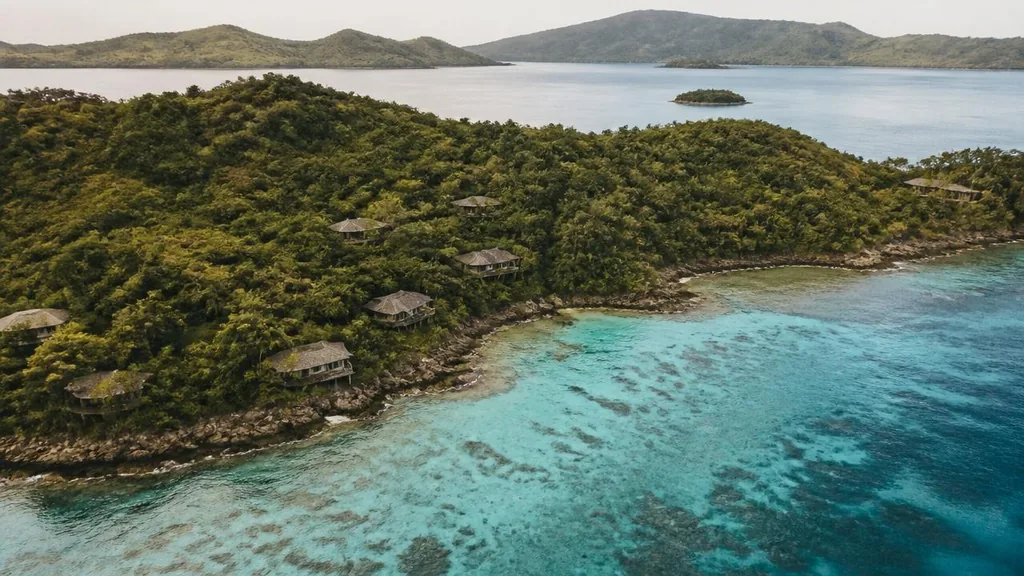
Indonesia · Carrying capacity & advisory board
Carrying capacity for a private island group
Villa expansion was on the table. The question was not whether the island could be built on, but what it could carry without losing the reef, the water table and the quiet that guests were paying for.
- Scope
- Carrying-capacity model across energy, water, waste and biodiversity
- Role
- Lead systems integrator, continuing advisory board seat
- Setting
- Private island group, Indonesia
- Regulatory frame
- Indonesian environmental approvals (AMDAL pathway)
The Situation
A private island group wanted to grow without breaking the systems that make its islands worth visiting.
What Enzyme Did
A carrying-capacity model across energy, water, waste and biodiversity, testing villa-expansion scenarios against infrastructure options including greywater recycling and hydrogen-enhanced diesel, aligned to Indonesian environmental approvals.
What Made It Hard
- Every additional villa draws on the same freshwater lens and the same waste stream — the constraints compound rather than scale linearly.
- Reef health is the asset. Nutrient load from expanded wastewater treatment sits directly upstream of it.
- Diesel generation set the emissions ceiling and the noise floor, both of which shape the guest experience.
- Approvals had to be earned on evidence, not on intent.
How the Work Ran
Established the baseline
Metered actual consumption across energy, water and waste rather than accepting design assumptions, then set that against observed biodiversity indicators on the reef and in the island's interior.
Modelled the limits
Built a carrying-capacity model that expressed each system as a threshold — the point past which recovery slows or stops — instead of a single occupancy number.
Tested expansion scenarios
Ran villa-count scenarios against infrastructure options including greywater recycling and hydrogen-enhanced diesel, showing which combinations bought real headroom and which only deferred the constraint.
Aligned to approvals
Structured the evidence so it mapped onto Indonesian environmental approval requirements, so the model served both the board decision and the regulator.
Stayed at the table
Enzyme continues on the group's advisory board, so the model is maintained against real operating data rather than filed after handover.
What Changed
Growth decisions now run through the island's limits, not around them. Enzyme continues to serve on the group's advisory board.
Growth decisions now run through the island's limits, not around them
The board has a shared, quantified view of what the island can carry, so expansion arguments are settled on evidence rather than instinct.
Infrastructure spend sequenced to the binding constraint
Capital goes to the system that actually caps growth first, rather than being spread evenly across all four.
An approvals case built on measurement
The same model that informs the board supports the environmental approval submission, removing a round of rework.
A living model, not a delivered report
The advisory board seat keeps the thresholds current as occupancy, weather patterns and infrastructure change.
Related thinking
Next step
Ready to start your project?
Book a conversation to discuss how systems integration can create measurable value for your property or destination.
20 minutes with Andrew. No pitch deck.